What is futures trading with prop firms?
If you want t
o start trading on large accounts without tying up all your own capital, you are looking straight at the world of futures trading with prop firms. In this world you do not just trade a small personal account; you tap into the capital of a prop firm, work under clear rules, and turn your edge in markets like equity index futures or crude oil into shared profits for you and the firm. Futures contracts are standardized agreements to buy or sell an underlying asset at a set price on a set date, traded on regulated exchanges such as CME. That structure makes them ideal for leveraged, rule based prop trading.
What futures trading with prop firms really means
Futures trading with prop firms means you trade exchange listed futures using capital allocated by a proprietary trading firm. The prop firm provides the buying power and you provide the strategy and discipline. The profits are then shared according to a profit split agreement. Unlike a traditional broker, a prop firm acts as your capital partner. Many modern futures prop firms operate online and allow remote traders to qualify through evaluations instead of being hired on site. You trade products such as equity index futures, interest rate futures, commodity futures and sometimes currency futures, all within a controlled risk framework.
How funded futures accounts work in practice
To understand the model of prop trading, you need to see how funded futures accounts are built. Typically you move through three stages.
Stage 1
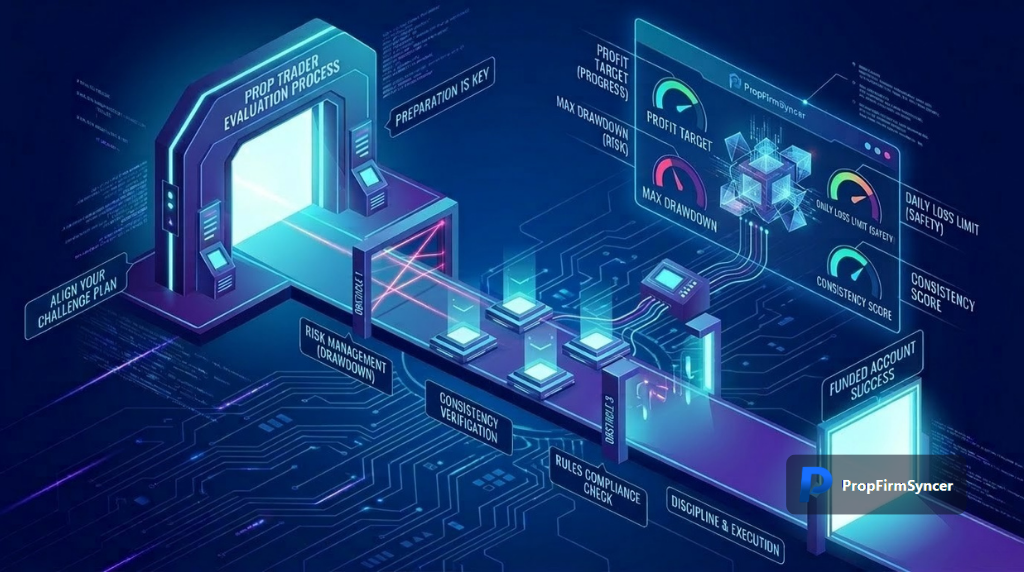
You trade an evaluation or challenge account. This is usually a simulated or internal risk account that mirrors real futures prices. You must reach a profit target while staying within the daily and total drawdown limits, and while following the trading rules such as minimum days or news restrictions.
Stage 2
If you pass, you progress to a funded or funded style account. Now your performance leads to real payouts, even if the risk is still managed via a simulated backend in many programs. You continue to trade futures under the same or similar risk rules, but you now share your profits with the prop firm, often at splits that can reach seventy percent or more in favour of the trader at some futures firms.
Stage 3
Many firms offer scaling plans. If you show a consistent, risk managed performance, they increase your capital allocation or allow larger position sizes. This scaling is one of the main reasons traders look at funded futures accounts instead of staying in small retail accounts.
Evaluations versus instant style access to funding
Not every futures prop firm follows the same path. The two big models you will see are classic evaluations and programs that promise faster or even instant style access to funding.
Evaluation model
In an evaluation model you pay a lower fee, trade through one or more phases and only gain a funded status once you hit the profit target without breaking the rules. This gives the prop firm a way to filter traders and reduces the chance that undisciplined trading hits their risk exposures.
Instant funded (style) model
Instant or fast track style programs let you start in a funded or funded style account much sooner, often after a single paid assessment or a very light initial check. In exchange you typically face stricter drawdown rules, higher upfront fees, or different payout conditions.
Your goal should not be just to access capital as quickly as you can, but to align your approach with the model that matches your risk tolerance, time, and trading style inside the futures markets you know best.
Key rules you trade under with futures prop firms
The rule set is what makes or breaks your experience with a futures prop firm. You can expect some combination of the following:
- You will have a maximum daily loss limit that caps what you can lose in any single trading day. You will also have a maximum overall drawdown threshold that you must not cross from the starting balance or from a trailing peak, depending on the prop firm. Many traders underestimate how quickly a few poorly controlled futures trades can hit these lines.
- Evaluations often include a profit target and sometimes a time guideline or minimum number of trading days. There may be restrictions around high impact news releases, holding positions into the close or carrying positions overnight, especially for the more volatile futures contracts. Payouts are usually scheduled at set intervals after you reach a minimum profit level and meet the activity requirements.
Every one of these rules exists to protect the capital of the prop firm. You need a trading plan that treats the firm rules as part of the structure, not as small print you read once and forget.
The benefits and trade offs of futures prop trading
Futures prop trading gives you several advantages that are hard to replicate in a traditional retail account, but each advantage comes with a trade off you need to understand.
Benefits
The first benefit is your quick access to sizeable trading accounts. Futures contracts are naturally leveraged instruments. When a prop firm allocates you a funded account, you can express your strategy at a scale that might be impossible with your own capital alone. That can accelerate your progress if you already know how to manage risk.
The second benefit is the limited direct personal downside. Apart from evaluation fees and any recurring charges, you do not you’re your personal savings when a funded account hits it’s a drawdown limit. The firm takes that capital risk, and you only lose the account, not your bank account, which can help you trade with more professional detachment.
Trade offs
You trade under external rules and can lose access quickly if you break them. Some prop firms may change their terms, adjust the payouts or face regulatory attention, especially if their business model relies heavily on evaluation fees or if live trading is limited. It is important that you choose your prop firm carefully and treat funded trading as a serious business relationship. Prop trading does not remove the risk, it repackages it. Your task is to decide whether that package fits your goals.
What type of trader tends to thrive with futures prop firms
Futures prop firms are not a good fit for every trader, and that is a strength rather than a weakness, because as a trader you should want align yourself with the prop firm, not just to access their capital. Traders who thrive in this environment usually have a clear focus on a small set of futures markets, an existing strategy with defined setups, and a strong respect for risk limits.
They also tend to accept structure. If the rules of a prop firm tell them to stop after a certain loss, they stop. If their plan limits them to a set number of trades, they honour that limit even when the market feels active. They keep records, review data and treat a funded futures account more like a small trading business and less like a casino.
If you like high emotion, constant action and ignoring stop losses, futures prop trading will likely amplify your weaknesses. If you like clear rules, measurable progress and the idea of trading a professional style playbook, it can be a powerful path.
Give yourself the best chance to grow as a trader
Futures trading with prop firms is more than a way to see a bigger number on your platform. It is a professional framework where a firm supplies you with capital and rules, and you supply the preparation, risk control and execution. When you treat that framework with respect, you give yourself a real chance to grow as a trader without exposing your personal funds. If this path interests you, take the time to understand how funded accounts work, how evaluations will test you and how rule sets will shape your day to day decisions.
7 Steps to Leverage the Resources on PropFirmSyncer the Best
If you want to move from theory to action, you do not have to build your own research workflow from scratch. With the resources available on our platform, we guide you every step of the way on your prop firm trading journey and help you build it into a structured path. The best way to start walking the path of prop firm trading, is to start with the foundations, then move into firm selection, then refine your execution and challenge tactics. Each step has a dedicated resource, and you can follow them in order.
- First, begin with the guide on what a prop firm trader is to anchor the basic concept and understand how trading firm capital differs from trading your own account.
- Next, go to our page Find Your Prop Firm Match to line up futures prop firms that fit your style, preferred markets and risk tolerance instead of scrolling endless lists.
- Then move into the prop firm trader success guide to build a clear challenge plan, set risk limits and design routines that help you actually pass and stay funded.
- After that, deepen your selection process on our page How to Choose a Prop Firm, where you walk through criteria such as drawdown limits, payouts and firm reputation in a structured way.
- When you are ready to see the whole landscape, explore the Prop firms directory to view top futures prop firms side by side and spot which ones deserve a closer look.
- To avoid surprises inside the evaluation, dive into the prop firm trading rules and compare rule sets in detail so that your strategy and the firm conditions actually match each other.
- Finally, sharpen your execution with the prop trading challenge tips, where you pick up practical tactics for managing risk, handling psychology and navigating evaluation pressure.
When you follow this path you turn prop firm trading from an abstract label into a concrete roadmap that starts with definitions and ends with a funded futures account backed by a firm that suits you.